SciFi Vision | Interviews | Robert Patrick on How Far Jeremiah Dunmire Will Go on Tulsa King + Remembering The X-Files
Robert Patrick on How Far Jeremiah Dunmire Will Go on Tulsa King + Remembering The X-Files
 In this week’s episode of Tulsa King, which premiered today on Paramount+, Cole Dunmire (Beau Knapp) tries to gain his father Jeremiah (Robert Patrick)’s approval after having stolen the fifty-year-old bourbon from Dwight Manfredi (Sylvester Stallone) in the previous episode, but it doesn’t gain him the recognition that he craves. Meanwhile, Manfredi’s crew comes up with a plan to get the bourbon back from the family after Tyson (Jay Will) realizes he was played by the stripper (H. Lynn Pai) and follows her to catch them unloading the Fifty. Holding Cole at gunpoint, Dwight trades Jeremiah his son’s life for the Fifty.
Recently, Patrick spoke with SciFi Vision about his role on the series, including working with Stallone and Knapp, what made him want to be a part of the series, connecting with the darkness of the character, how far Jeremiah is willing to go to get what he wants, what he’s learned from the experience, working on the series The X-Files over twenty years ago, and much more.
Watch the inteview and read the transcript below.
SCIFI VISION: What was it about Tulsa King, that made you want to be a part of it?
ROBERT PATRICK: Well, you know, I just love acting, and I love being a part of something that's so visible. You know, if you're going to do Tulsa King, you know that people are going to watch it. It's a great show. I had been watching the first two seasons. I had kind of thought maybe they would ask me to do the show, and I was excited about it.
I've worked with Sly twice before. I've a great experience working with him. I have so much respect for him as an artist. I think he's incredible, what he's achieved in his life. So, I was open to the opportunity, and God bless him. They gave it to me, and they gave me such a great role.
So, Jamie, I mean, there's so much going on behind Jeremiah making me look good. The way they're shooting him. They're adding to the imposing quality that he has. They're really taking care of me. They gave me my own little theme music when I show up. So, they're helping me so much to be a formidable adversary for Sly's character. So, I just kind of walk in and do it, you know, just show up, know my dialogue, and get in there and play. And that's what's fun.
SCIFI VISION: Did they give you more at the beginning kind of, of how he got where he is, or did you make more up in your head to kind of get deeper into the character?
ROBERT PATRICK: Well, I met with David on a Zoom call, we were talking, and we were discussing the character, and they were telling me what they were thinking. And I thought, “Well, this is fantastic. I get this.” This is a legacy. This is a guy that represents generations of this distillery business. They came from moonshining. I understand that, as a Scots-Irish American, certainly, you know, my ancestors up in Appalachia, I get all that. So, that gave me a good foundation to build on. And I am a Christian, so I understand the Bible, and I understand the religious tones that are on with this. So, I felt like I had a good grip on the guy.
Visually, I suggested the way I wanted to look. I wanted to look like I'm wearing my ancestor's suits. I probably patterned my look after my father, who patterned it after his father. And, you know, I requested to wear the Stetson Open Road and have those glasses and kind of had an LBJ kind of look in my head. And really, to be honest with you, Suzanne, the costumer, they were - all that kind of just builds the character. And then you get in there and fill the suit up and go from there. Does that make sense? Does that help a little bit?
SCIFI VISION: Yeah, I was going to say, do you ever have trouble connecting with the darker parts of the character? I mean, obviously, you've done a lot of villains, so it's not like this is new.
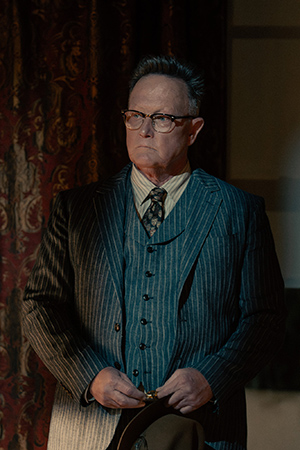 ROBERT PATRICK: Yeah, well, everybody has darkness, you know, as human beings. There's the light side of us and the dark side of us, and we can all be pretty dark if we let ourselves go that route.
And so it's certainly something that we can grasp. So, I understood it and based it more on, you know, the relationship, who the guy was, how he was raised, the environment he came from, how strict his environment was with his father and his father's father. So, again, going back to that legacy of this is the way it is.
So, in my mind, to be honest with you, Jamie, I see Jeremiah as almost a victim in the sense that my life was fine until this Manfredi shows up, and he's invading my territory. And what do you do when your territory gets invaded? You fight back.
SCIFI VISION: That was the one thing I want to ask, too, is I feel like he's not as much caring about the bourbon and the money as he is wanting to get revenge, which probably will be his downfall in the end. But talk a little bit about that.
ROBERT PATRICK: Well, it is it is about the bourbon and the money, but it's more about the family and the legacy and the tradition and the fact that our tradition is being threatened. And that's a metaphor for a lot of what's going on in the world right now. He's resistant to change, and he doesn't want change to happen.
And he feels like he's being invaded. So, I think there's a lot of people out there that'll be watching the show, and they'll pick up on that, because that's really what it's about. It's about a territory. It's about an invasion. It's about being forced to change and let go of the traditions that you've hold or the things that you care about and being forced to change, and he doesn't want it to happen.
I think, you know, I hope that when I burned down Montague's house, that whole scene I have with Montague, I mean, that was an old friend of mine, and he's betrayed me. And in the Bible, when you betray, you know - I mean, rough, you know, and I think I really tried to take the time with that scene to let Montague know that it's not going to be good for you. I mean, you're forcing me to do something, and I even say that in dialogue to Manfredi. I mean, you have now forced me to - I am obligated to tear you apart and everything you love.
SCIFI VISION: I get that. Let me ask you, do you think he can go too far? Or, like how far will he go? Because I kind of thought for a moment that he was going to let Dwight kill his son. And obviously he didn't, but yeah, I didn't know how far it was going to go.
ROBERT PATRICK: Okay. I think that that's exactly what I wanted you to think. And I think that that's exactly what Jeremiah wanted Dwight to think.
And I think that shows you how far you're in it, you know, how far you're willing to go. Yeah. And that's biblical too.
I mean, you know, how many times did the Lord tell someone to sacrifice their son? And will you do that for me? So, it's all intertwined.
And I really feel like, you know, he wants you to think he is willing to go that far and will sacrifice his son to keep his family's tradition alive.
SCIFI VISION: All right. That's fair. Talk about working with Beau.
ROBERT PATRICK: Well, you know, Beau is a terrific actor. He's a wonderful, wonderful, sweet guy. And I sort of made it difficult for Beau, not in a real, you know, mean, adversarial way, but I didn't let him in as an actor. I didn't – he reached out to me, and I was getting on an elevator. He said, “I'm Beau Knapp, and I'm playing your son.” I said,”Oh, yeah,” and the elevator door closed. That was essentially how I kept it. I kept him at way arms length. And the only time I worked with him, the only time I interacted with him, was when we were on camera. We did not socialize. We did not get familiar, and I think it helped both of us.
SCIFI VISION: All right. I wanted to ask you at least one question about The X-Files before I go, if you don't care.
ROBERT PATRICK: I love The X-Files.
SCIFI VISION: Yeah. Well, it’s my favorite.
ROBERT PATRICK: My favorite character.
SCIFI VISION: Well, what's one memory you have that still sticks out as maybe the best memory or the craziest memory or just something that kind of sticks out?
ROBERT PATRICK: Well, you know, that show was wonderful in the way they introduced me and Chris Carter and Frank Spotnitz, the way they introduced that character. And I think when Gillian throws water in John Doggett's face and says - you know, because basically I was kind of lying to her, trying to find out where Mulder was and that whole kind of thing.
I think it introduced me to the fans. The fans were so against somebody coming in, and in their mind, apparently trying to replace David Duchovny, which was not what it was about. It was about creating a whole new character and a new dynamic so the show could continue for the fans.
But I think that, that first episode, there was also another episode I did, “John Doe.” It was a lot of cool things that they gave my character after the loss of my son, some closure on that.
And, you know, my real wife got to play my divorced wife on that show. So, that was a lot of fun, but I had great memories.
I love Gillian. She’s wonderful. I loved Annabeth. My favorite experience, my favorite character I've ever played.
SCIFI VISION: Cool. Very cool. Yeah.
I never understood why you couldn't both exist in the universe though.
ROBERT PATRICK: I mean, look behind you. It's a big universe.
SCIFI VISION: It is. You've been in so many different IPs. I mean, obviously Terminator, The X-Files, The Walking Dead, even Lost. Are there still things that you learn as an actor? Like, what have you taken away from Tulsa King? What have you learned?
ROBERT PATRICK: Well, I think that, you know, I've been doing it 41 years, and even started before [with] Roger Corman and the B movies. That's where I really, that was my film school. And I think every time you work as an actor, you learn something. You're going to get something. Also, not only are you learning, but you're going to gain more confidence, and all that becomes a part of your arsenal when you show up to work, whatever that next role is. So, the more situations you put yourself in, and the more situations you've been in as an actor and different roles you've played or different films, different budgets, different timeframes, how fast you’ve got to go, it all puts demand on you and pressure to find your way of completing the problem of finding that character and making it work. And you’ve got to do it in front of a camera. So, it all helps every job. And there's a part of me that, I just work sometimes just to keep working. I'm not a big, like “I want to take a whole year off kind of guy.” I'm a, “I want to keep working.” I like to have my chops – you’ve got to keep stretching out, you know what I mean? So, I try to stay busy.

Latest Articles
Interviews
 Tommy & Tuppence: Josh Dylan and Antonia Thomas on Modernizing Agatha Christie
 Tuesday, 15 September 2026
 Jimmi Simpson Breaks Down Dillard’s Walker Family and His Shocking Turn on The Walking Dead: Dead City
 Sunday, 13 September 2026
 Aimee Garcia on Renata’s Hope, Trauma, and Walker Transformation in The Walking Dead: Dead City
 Sunday, 13 September 2026
 The Walking Dead: Dead City's Showrunner on Moving Maggie & Negan Forward, Episode 6 & Where a Potential Season 4 Could be Headed
 Thursday, 10 September 2026
 Dark Matter Season 2: Jennifer Connelly and Joel Edgerton on the Emotional New Season
 Saturday, 05 September 2026
 Dreams in Nightmares: Charlie Barnett, Sasha Compère & Mars Storm Rucker Talk Personal Truths & More
 Friday, 04 September 2026
 Murderbot: Hazel Baird and Rob Cawdery of Elastic on Creating the Emmy-Nominated Main Titles
 Monday, 24 August 2026
 Monarch: Legacy of Monsters - VFX Supervisor Sean Konrad on Designing Titans, Emmy-Nomination & More
 Sunday, 23 August 2026
 Son of Sara: Tymika Tafari on Carol's Devotion, Fight Scenes & Volume Two Hopes
 Tuesday, 11 August 2026

Reviews


