SciFi Vision | Interviews | Star Chris Pratt & Director Timur Bekmambetov on Bringing Mercy to Life on Screen
Star Chris Pratt & Director Timur Bekmambetov on Bringing Mercy to Life on Screen
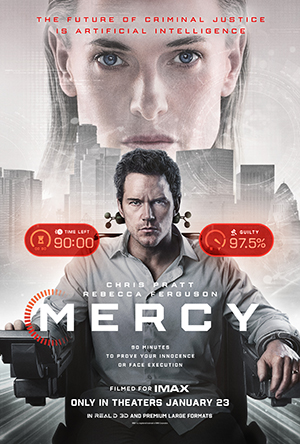
 In Mercy, which premieres in theaters on Friday, in the near future, Detective Chris Raven (Chris Pratt) is accused of murdering his wife and stands on trial, the judge the artificial intelligence he championed, Judge Maddox (Rebecca Furguson). With no memory of what happened before he woke up in the Mercy Chair, he is given 90 minutes to comb through all available surveillance footage to prove his innocence. However, if he’s found guilty, he will be executed instantly.
SciFi Vision recently spoke with star Chris Pratt about being restrained in the chair and how it both helped and hindered his ability to portray the detective. “The sense of claustrophobia, the sense of feeling trapped, being isolated in a room, a cavernous space, this cacophonous volume that I was confronted by, nothing other than digital screens, that's what my character's going through,” he explained, adding that it was similar to what he himself was going through as he filmed the scenes.
Pratt was joined by director Timur Bekmambetov who explained that although Pratt was in the chair for a large portion of the film, there is also a lot of evidence around him on the screen. “[It’s] a full of action, full of events of his life, because he's in the chair, but all his backstories are around him, and we see him fighting, chasing,” said the director.
“[I]t's very much an action forward film,” added Pratt. “Just, rather than being the person who's perpetrating the action, I'm sort of subject to witnessing the action along with the audience.”
Mercy comes to theaters nationwide starting this Friday.
Watch the interview and read the transcript below.
SCIFI VISION: My first question's for you, Chris. Because you were physically restrained for a significant portion of the film, did that make it at all difficult to kind of find ways to portray his intensity since you couldn't move around a whole lot?
CHRIS PRATT: In some ways, yeah, but in other ways it really helped. The sense of claustrophobia, the sense of feeling trapped, being isolated in a room, a cavernous space, this cacophonous volume that I was confronted by, nothing other than digital screens, that's what my character's going through. It was also what I was going through doing the movie. So, yes, there are certain limitations in regards to my ability to gesticulate or move my body or use my body as an instrument freely, but the fact that I wasn't free, in a way, allowed me to have to express myself through just my facial expressions or my voice or my breath.
 So, yeah, it came with its sense of challenges. And also, including, because we were allowed to shoot really long takes, because I wasn't jumping from one set to the next or any of that kind of stuff, we were able to just point the camera in a direction and roll. And then we'd roll through 40, 50, 60 minute long takes. And it was really in that way also a challenge, because I'm not used to doing that in film. Film you might do three pages or five pages maximum in a day, and so to go through 40, 50, 60 pages was another challenge.
TIMUR BEKMAMBETOV: But I would like to add, because it is 90 minutes, Chris in the chair, but at the same time, there is a lot of evidences around him, and [it’s] a full of action, full of events of his life, because he's in the chair, but all his backstories are around him, and we see him fighting, chasing.
CHRIS PRATT: Yeah, and everything that is happening outside of the Mercy Chamber is also represented to me through these screens. So, there's a massive fight for my life on behalf of my partners outside of this. Well, meanwhile, like crazy car chases and shootouts and various stunts. So, it's very much an action forward film. Just, rather than being the person who's perpetrating the action, I'm sort of subject to witnessing the action along with the audience.
SCIFI VISION: Timur, what are some of the challenges that you found that were unique for this film, for creating your vision?
TIMUR BEKMAMBETOV: It was quite comfortable to make this movie, because we had a great partners, and we had a support from producing partner, from studio, it was quite like, easy. And we just, we had a lot of tools to play with. The new technology, the virtual set, and AI tools to analyze. We never used AI, but we learn - the challenges [were] how to make it look grounded, to make it real, to make it relatable. But it's what usually we do.
CHRIS PRATT: That's always the challenge, right? Trying to ground it in some sense of reality. It's science fiction, but trying to make it feel like it's not outside of the realm of possibility to put audiences into the seat to where they go, “Wow, this is very close to what could really be happening in 2029.”

Latest Articles
Interviews
 Tommy & Tuppence: Josh Dylan and Antonia Thomas on Modernizing Agatha Christie
 Tuesday, 15 September 2026
 Jimmi Simpson Breaks Down Dillard’s Walker Family and His Shocking Turn on The Walking Dead: Dead City
 Sunday, 13 September 2026
 Aimee Garcia on Renata’s Hope, Trauma, and Walker Transformation in The Walking Dead: Dead City
 Sunday, 13 September 2026
 The Walking Dead: Dead City's Showrunner on Moving Maggie & Negan Forward, Episode 6 & Where a Potential Season 4 Could be Headed
 Thursday, 10 September 2026
 Dark Matter Season 2: Jennifer Connelly and Joel Edgerton on the Emotional New Season
 Saturday, 05 September 2026
 Dreams in Nightmares: Charlie Barnett, Sasha Compère & Mars Storm Rucker Talk Personal Truths & More
 Friday, 04 September 2026
 Murderbot: Hazel Baird and Rob Cawdery of Elastic on Creating the Emmy-Nominated Main Titles
 Monday, 24 August 2026
 Monarch: Legacy of Monsters - VFX Supervisor Sean Konrad on Designing Titans, Emmy-Nomination & More
 Sunday, 23 August 2026
 Son of Sara: Tymika Tafari on Carol's Devotion, Fight Scenes & Volume Two Hopes
 Tuesday, 11 August 2026

Reviews


