SciFi Vision | Interviews | Writer & Director Aram Rappaport on Shooting the Unique Series The Artist: "It Was Mayhem"
Writer & Director Aram Rappaport on Shooting the Unique Series The Artist: "It Was Mayhem"
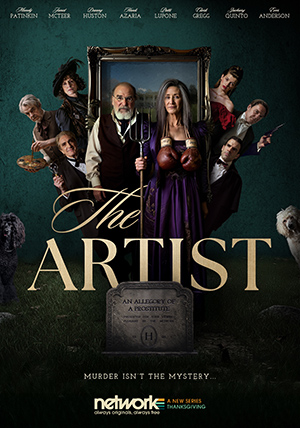
 Part one of the new series The Artist comes to The Network this Thanksgiving. The series features a blend of real-life historical figures and a fictional story created by Iram Rappaport, who also directed the murder mystery. Set in New York’s high society during the Gilded Age, the story follows eccentric tycoon Norman Henry (Mandy Patinkin) and his wife, Marian (Janet McTeer) as they host the biggest celebrities of the era at their extravagant home. Their guests include scientist Thomas Edison (Hank Azaria), artist Edgar Degas (Danny Huston), and model and actress Evelyn Nesbit (Ever Anderson) as she becomes known overnight after her husband, Harry Thaw (Clark Gregg), murders the architect Stanford White during an event at Madison Square Gardens. However, truths are revealed, and by the end, Henry is found dead, launching the historical murder mystery.
In developing the series, writer and director Rappaport wanted to capture something that felt unpredictable. “I would say it’s a scorched earth, Gilded Age murder mystery where you don't know who's dead, who's dying, who's doing the killing or what historical facts are accurate until the very end,” he told SciFi Vision. “…You don't know what's real and what isn’t.”
He began shaping the idea during the recent writers’ and actors’ strikes. The tension he saw in the industry became a creative spark. “I just saw the polarization between these creatives and these artists that were fighting for a little bit, these, you know, presumptive kings of the industry who were deeply in debt…but still felt entirely in control of the artists that essentially produced for them,” he told the site. Setting the story during the Gilded Age allowed him to mirror those power imbalances.
Casting the series meant building roles around the actors he brought onboard. Rappaport explained that the process began with Mandy Patinkin, but it took time for the actor to connect with the material. “[H]e sort of didn't understand it and passed on it,” Rappaport said. After meeting again and explaining that the tone wasn’t as dark as he thought, Patinkin signed on with one condition, which helped shape the rest of the series. “He had one condition, that we sort of shoot it like a love story and that even though these two people have sort of fallen out of love and hate each other, they sort of find it again.”
From there, the characters continued to evolve as other cast members joined and he wrote specifically to their voices, including Hank Azaria, Patti LuPone, Katherine McPhee, and Clark Gregg, “[T]he idea was to push these people to do something that they hadn't done before maybe, and unfortunately we had to do it very quickly. So, they had to trust quickly, but it worked.”
When it came to performance, Rappaport encouraged the ensemble to bring their own instincts and research. Some stuck closely to the script while others improvised. “I think everyone knew their characters better than I did, and I think all I can do is really craft a story that hopefully has strong intentions and then just let them go with it.”
The director also spoke to filming the iconic scene in the third episode with ClarkGregg that involved a lavish event that included camels. “[I]t was total mayhem,” he said of the big sequence. “I think it was like the second to last day of our shoot, our very short shoot…When he came in, I didn't have to do much. I think he sort of zoned in on what he was trying to accomplish, and even though it was sort of like big and manic, he really set the tone in that scene and led in a way that Harry Thaw probably would have. So, it was a lot easier than I thought.”
The locations also played a key role in shaping the series. Much of it was filmed at the Hillstead Museum in Hartford, a living art collection filled with real Monets and Degas pieces. Rappaport admitted it was daunting. “Yeah, it was terrifying,” he said, though the museum staff helped the production navigate the space.
Part one of The Artist premieres on The Network on November 27th, followed by part two on December 25th.
Watch the full interview and read the transcript below.
**Edited for clarity and length**
SCIFI VISION: I've enjoyed the first three episodes, looking forward to getting to see the rest.
ARAM RAPPAPORT: Firstly, thank you for watching the first three episodes. That's a commitment, and I really appreciate it.
SCIFI VISION: That was a lot of fun. I enjoyed it. So, for people who haven't seen it, kind of talk about what it is. I mean, it's very unique, at least to me. I think it's very unique.
ARAM RAPPAPORT: Yeah, I mean, I would say it's a scorched earth, Gilded Age murder mystery where you don't know who's dead, who's dying, who's doing the killing or what historical facts are accurate until the very end.
SCIFI VISION: That's what I was gonna say. It's got historical parts to it, but it's not all.
ARAM RAPPAPORT: Yeah, but you never know. You don't know what's real and what isn't when it comes to…
SCIFI VISION: Yeah, I'm not sure that one of those people in real history was a murderer - well, other than Thaw. [laughs]
 ARAM RAPPAPORT: Yeah, yeah, yeah, yeah, right, right. No, that's, yes, exactly, exactly.
SCIFI VISION: But how did you come up with the idea though?
ARAM RAPPAPORT: Yeah, so for me, I started developing this during the writers' strike and the actors' strike. I just saw the polarization between these creatives and these artists that were fighting for a little bit. Then these, you know, presumptive kings of the industry who were like deeply in debt, you know, forty, fifty billion dollars, over leveraged at their company, but still felt entirely in control of the artists that essentially produced for them.
So, to me, it was like, if we set something in the Gilded Age during this boom, but it's like a failed tycoon who still felt like he was in power, and still felt like these people were all just like sort of whores to him. It would sort of mirror what we were going through in the moment. So, I thought, as I started developing it, it was like, this is a great time period and there's disruption with the Impressionists, and let's bring in a ballerina, and let's do, you know, and then everyone really, from Thomas Edison down, was someone who was an artist and was creating, and it was like sort of in the middle of their own renaissance. And it felt like that would be sort of a pressure cooker situation if we added a murder and made it feel as if no one was gonna survive the night.
SCIFI VISION: Yeah, I was gonna say, I liked too that he keeps saying, you know, “I'll owe you the money, I'll give it to you. [laughs]
ARAM RAPPAPORT: Yeah, yeah, yeah, yeah, yeah, yeah.
SCIFI VISION: He expects them to fall for it, right? So talk about casting.
ARAM RAPPAPORT: Yeah, I mean, we started with Mandy Patinkin, and I had like an episode or two written and went to Mandy and he sort of didn't understand it and passed on it. And then I went back to him and met with him and sort of explained it to him, that this was like a Russian comedy, and it wasn't as dark as he was reading it. He had one condition, that we sort of shoot it like a love story and that even though these two people have sort of fallen out of love and hate each other, they sort of find it again.
So, I think with the help of him and Janet and other players, I wrote the back half of the show. Like I had set it up, but I think I really wrote these characters to actors who wanted to come in and play.
Like Hank, I think I really pitched him on like what this was. Then, Hank said, “Yes, let's do it.” And then I wrote to his voice, and we found a way to like create that character. For him, same with Patti LuPone. I had dinner with her, and she hadn't even read it yet, and she knew Mandy was doing it, and she'd obviously worked with Mandy. I just said, “Look, can I like write something for you that you want to do? Like, what do you want to play? What would you be proud of?” And then I just wrote to her.
Same with Kat McPhee, same with Clark Gregg. That was another one where Clark really like sort of trusted the process and came in, and the idea was to push these people to do something that they hadn't done before maybe, nd unfortunately we had to do it very quickly. So, they had to trust quickly, but it worked.
SCIFI VISION: I was going to say, you mentioned Clark Gregg. Talk about filming that scene with Thaw shooting Stanford, because that, I mean, you've got a camel; you've got swings and stuff going on. Yeah, that was a great scene. Talk about that.
ARAM RAPPAPORT: Yeah, it was like total, it was total mayhem. I think it was like the second to last day of our shoot, our very short shoot. But I think what was what was interesting about that is that Clark is he's a director and a writer and a revered stage actor, you know, as well as the Marvel stuff, like we don't often see him do his off-Broadway stuff or write a play, but this whole thing was staged as a play really.
So, when he came in, he really, I didn't have to do much. I think he sort of zoned in on like what he was trying to accomplish, and even though it was sort of like big and manic, he really set the tone in that scene and led in a way that Harry Thaw probably would have. So, it was a lot easier than I thought. We kind of set up cameras, and I just said, “Ooh, I'm not going to disrupt his process. He knows what he's doing. I'll film it, and we'll move on.”
So, I mean, I think the camels were the most difficult that day. They shat all over the extras. So, that was the hardest part of the day.
SCIFI VISION: [laughs] That's funny. I was going to say say, it's quite a spectacle though in the best way that scene.
ARAM RAPPAPORT: Yeah, if you've never seen feces spraying out of the back of a camel.
SCIFI VISION: I hope I never do. [laughs]
ARAM RAPPAPORT: Spinning around in fear. Yeah, you should try it.
SCIFI VISION: Talk about the locations. Because I know I'd heard from some of the other actors about you filming like where they had a real Degas and that kind of thing. So, yeah, talk about the location.
ARAM RAPPAPORT: Yeah, for us to like afford to even really shoot a show like this, we almost had to come in to some sort of museum like atmosphere where they were gonna let us shoot. And it was limited set dressing, you know, something of the Gilded Age. So we were looking all the way from Rhode Island down.
And unfortunately, the show the Gilded Age has overshot Rhode Island up and down the coast. They've done a lot in those. So, we were trying to stay away from that world and create something a little bit grittier.
And we ended up finding a museum called Hillstead in Hartford, Connecticut, that is a living art collection. So, Theodate Pope, who's a female architect who built the house, and her father was a robber baron in his own right, had this art collection and they just acquired things that they liked. And that happened to be like multiple Monet haystacks and Monets and Degas and, you know, really, really in-depth. I mean, they must have two and a half billion dollars worth of art there, and all of it was real. And we were allowed to live in the house and shoot there as long as we didn't use real candles.
SCIFI VISION: Was that daunting though? Because I mean, if it was me, I'd definitely be freaking out that I was going to break something.
ARAM RAPPAPORT: Yeah, it was terrifying. No, it was totally terrifying. And I think they were great. I mean, the museum, you know, Anna who runs the museum there was unbelievable. She really trusted that, you know, her job as a curator of this museum is to like be a custodian of art, and if that meant us coming in and sort of highlighting the house in that way, she was going to allow it and figure out a way to efficiently get us in and out without ripping, you know, a $500 million painting.
But I do have to say that the museum in and of itself is like the hidden gem of the US art community, because they are like one of the foremost collectors of Degas and Monets, and you just don't know about it. You walk in, and you're an inch from these, you know, Monet Haystacks in a living room, and that's how they were meant to be viewed.
SCIFI VISION: Talk about recreating the time period.
ARAM RAPPAPORT: Yeah, I mean, for me, I think it's like a lot dirtier and more scorched earth and more foul mouthed than what we see on television, especially. So, I think, for me, it was like, I was intent on creating something that felt really sloppy and vivid so that we could juxtapose like all this other, like very clean, you know, British period or the Gilded Age or like these shows where there's no sweat stains, the streets are flawless, there's no horse poop, there's no, you know, I mean, it's like a very bleached version of what this very dirty, dirty period would have looked and felt like. So, for me, that was super important, and for Janet McTeer also, she really set the tone from a wardrobe perspective. She wanted this to be like Grey Gardens if it was set at this house in the Gilded Age, and that was really the tone that we followed.
SCIFI VISION: Like I said, I think I liked the ballroom, the whole fight [scene], but what was your favorite scene, without spoiling too too much?
ARAM RAPPAPORT: Oh yeah, I love the ballroom fight for sure. I think that was, yeah, I love that. And I love the dinner scene when Evelyn gets there, and they're all just sort of like sitting around the table. I think it was also one of the most challenging scenes to shoot, to get the tone right. But it's just, I love those scenes where you can just sit a bunch of great actors at a table who all have conflicting motives and just let them go. And that's what we did when we shot that scene. I think that's really fun and sort of something I'm proud of.
SCIFI VISION: Yeah, did they kind of add a lot of their own stuff? Beause it sounds like Mandy just kind of improv sometimes.
ARAM RAPPAPORT: Yeah, yeah, so I think they all did. I mean, I think everyone knew their characters better than I did, and I think all I can do is really craft a story that hopefully has strong intentions and then just let them go with it.
So, I think some actors were more comfortable with that than others. You know, some wanted to come in and say the words and that was fine, and then others wanted to come in and try a lot of things and trust that we weren't going to use the bad things.
And I think, for me, it's just all about like, you know, if we can go into a situation where there's real trust and we can all hold hands and fail and then fail up and then do it better and then do it better. That's the best way to go about it, and I think Mandy was a perfect example of that. He would come in and, you know, maybe it wasn't right five times, but it was still truthful. And, you know, he's a genius, but then on the sixth time, he's like, “Wait a sec, this is how I want to do it,” and we would go with that.
Same with Ever Anderson. I mean, she would come in with alt lines. She helped practically, you know, rewrote her whole role and did more research than anyone else and had all these anecdotes about Evelyn Nesbit, and it's like, “Yeah, throw them all in wherever you think they make sense, and we'll use them if we can.”

Latest Articles
Interviews
 Summer's Last Resort: Jerry O'Connell, Sophia Bush & Violet McGraw on Comedy, Chaos & Water Park Fun
 Friday, 03 July 2026

 FROM Stars Nathan D. Simmons and Kaelen Ohm on Their Characters' Emotional Exits
 Tuesday, 30 June 2026
 FROM Star Pegah Ghafoori on Fatima's Transformation, Fan Theories & What's Next
 Monday, 29 June 2026

 Spider-Noir: Production Designer Warren Alan Young on Building in Both Color and Black & White, Creating 1930s New York & More
 Thursday, 18 June 2026

 The Season: Chris Pang & Justin Chien on Costumes, Party Scenes, and Hong Kong
 Wednesday, 17 June 2026
 The Terror Devil in Silver: Star Chinaza Uche on Grounding Coffee, Avoiding Stereotypes, and His Final Scene
 Wednesday, 10 June 2026
 Stars Scott McCord & Robert Joy Break Down the Emotional Fallout of FROM's Latest Twists
 Tuesday, 09 June 2026
Reviews


